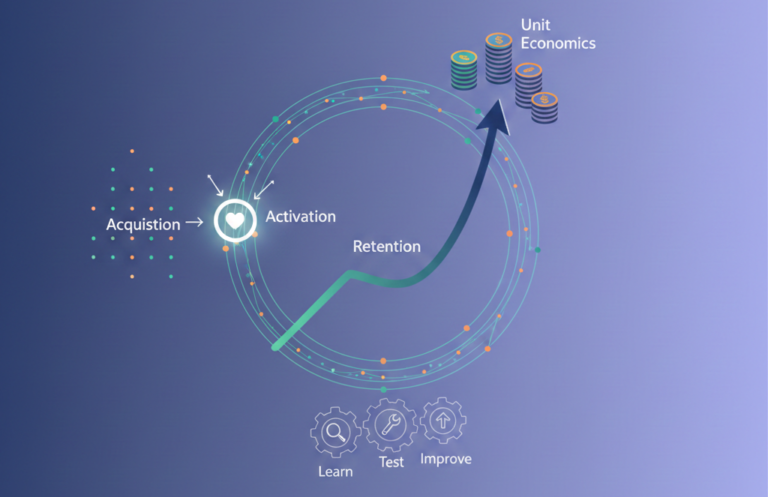
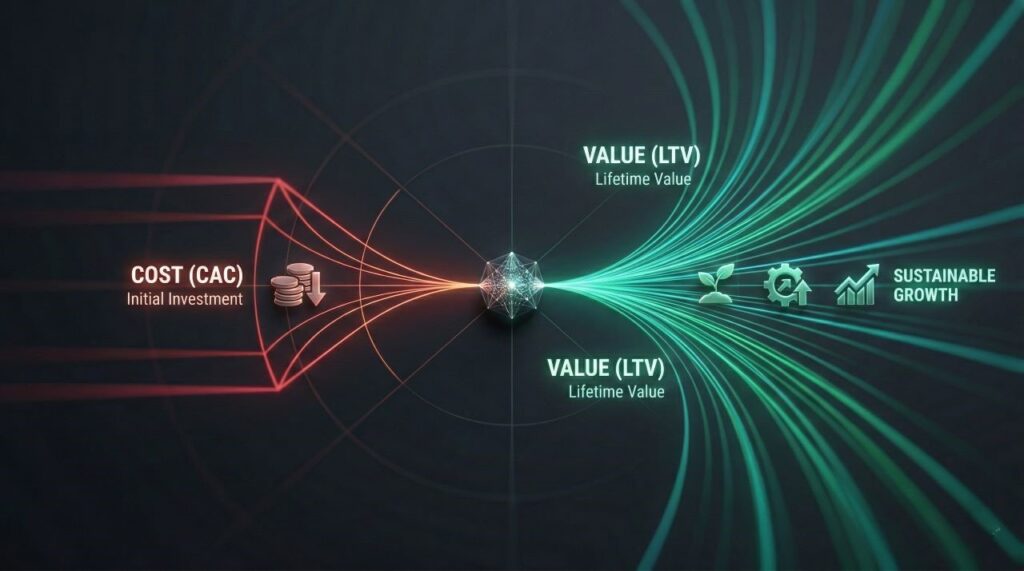
Most SaaS founders are entirely delusional about their profitability. You celebrate a record-breaking month of new signups, but your bank account is quietly bleeding dry.
If your acquisition costs exceed your customer lifetime value, you are running a very stressful charity, not a business. Top-line revenue means absolutely nothing if your fundamental math is broken.
The TL;DR
- Calculate a fully loaded CAC. Exclude nothing—factor in every software subscription, sales commission, and agency fee.
- Your LTV:CAC ratio is your ultimate health check. Aim for 3:1. Anything lower means you lose cash; anything higher means you are growing too slowly.
- Payback period dictates your survival. A massive LTV means nothing if it takes you 24 months to recover the initial cost of acquiring that user.
Stop Flying Blind: Why SaaS Unit Economics Dictate Your Survival
SaaS unit economics measures the direct revenues and costs associated with a single customer. You have to strip away the noise of your total revenue and look closely at the micro-level.
If you make money on one user, you will make money on ten thousand. If you lose money on one user, scaling will only bankrupt you faster. You must relentlessly track Customer Acquisition Cost (CAC) and Lifetime Value (LTV) to survive in this market.
The Brutal Math Behind Customer Acquisition Cost (CAC)
Your CAC is the exact dollar amount you spend to acquire one paying user. The formula is simple: divide your total sales and marketing expenses by the number of new customers acquired. But do not lie to yourself here.
Most founders calculate a fake CAC by only counting their ad spend.
![A clean, custom-branded infographic showing the fully loaded CAC formula (Sales + Marketing + Tools + Salaries / New Customers).]](https://rakibulsumon.com/wp-content/uploads/2026/02/image-2-1024x558.jpeg)
A true, fully loaded CAC includes everything. Add your sales team salaries, marketing agency retainers, and the cost of your CRM. Divide that massive number by your new users to see what growth actually costs you.
Pro Tip: Never rely on a “blended CAC” that mixes paid acquisition with organic traffic. This hides the true cost of your paid channels. Calculate your paid CAC and organic CAC separately to see exactly which campaigns burn your cash.
Lifetime Value (LTV): Predicting Your Revenue Engine
LTV is the total gross margin a customer generates before they cancel their subscription. It tells you exactly how much a user is worth over their entire relationship with your software.
You need three numbers to find it: your Average Revenue Per User (ARPU), your Gross Margin, and your Customer Churn Rate.
Multiply your ARPU by your Gross Margin, then divide that by your Churn Rate. If your churn rate spikes, your LTV instantly collapses. You cannot build a sustainable SaaS if your users leave after three months, so fix your product experience before pouring more money into marketing.
The LTV:CAC Ratio: Your Ultimate Health Diagnostic
Investors obsess over the LTV:CAC ratio for a very good reason. It mathematically proves whether your business model actually works in the real world. This ratio compares the value of a customer to the cost of acquiring them.
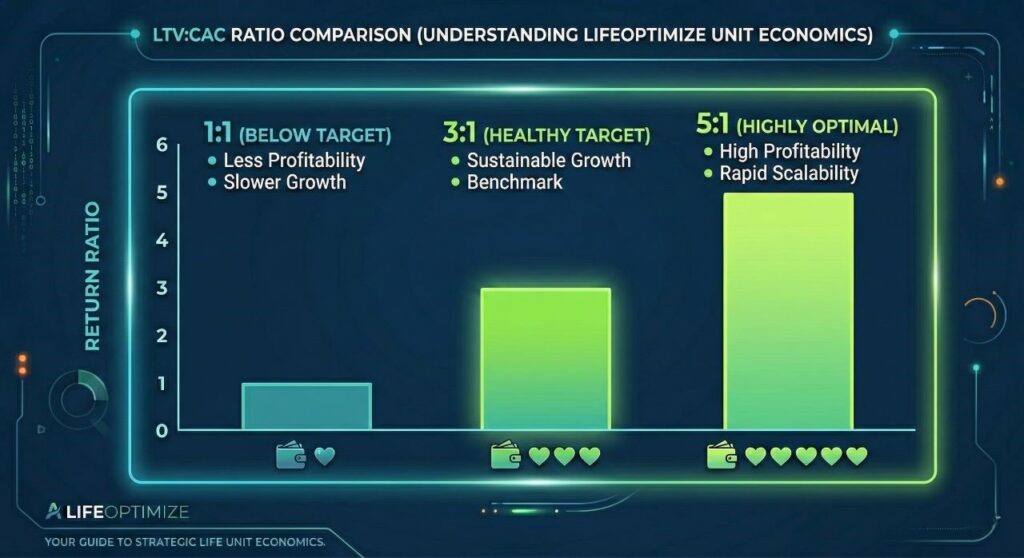
- 1:1 Ratio: You are marching toward death. One minor market shift will destroy you.
- 3:1 Ratio: The gold standard. You generate three dollars of value for every dollar spent.
- 5:1 Ratio or Higher: You are leaving money on the table. Spend more aggressively on marketing to capture more territory.
Payback Period: The Cash Flow Assassin Nobody Watches
A 4:1 LTV:CAC ratio looks amazing on a pitch deck. But if it takes you two years to earn that money back, your business will choke to death on cash flow constraints.
Your CAC Payback Period is the number of months it takes to recover your acquisition costs. Divide your CAC by your monthly gross margin per user. Most startups simply do not have the runway to float a customer for 18 months. Aim for a payback period of 6 to 12 months.
From the Trenches: How We Fixed a Leaky $5M ARR Bucket
Let me share a reality check from a recent audit of a B2B project management tool. They proudly hit $5M in Annual Recurring Revenue (ARR). The founders were thrilled, but they were quietly bleeding $150,000 in cash every single month.
They blamed their ad agency for the burn rate, so I dug into their unit economics. Their global LTV:CAC ratio sat at a mediocre 1.5:1. But looking at a global average is a massive trap.
We split their metrics by acquisition channel, and the data told a completely different story. Their outbound sales cohort had a brutal CAC of $800 with an LTV of just $1,200. Meanwhile, their organic product-led growth (PLG) signups boasted a $150 CAC and a $2,100 LTV.
![A blurred Baremetrics or Stripe dashboard screenshot showing LTV and CAC metrics segmented clearly by sales-led vs. product-led channels.]](https://rakibulsumon.com/wp-content/uploads/2026/02/image-1-1024x558.jpeg)
Their expensive outbound motion was actively subsidizing a high-churn user base. We immediately slashed 80% of their ad spend and outbound SDR efforts. We redirected that energy entirely into removing friction from their self-serve onboarding.
By dropping credit card walls and implementing a reverse trial, we let users experience the core product instantly. Faster “Aha!” moments dramatically improved free-to-paid conversion rates. Within four months, their blended CAC dropped by 40%. Top-line MRR growth slowed down slightly, but their cash burn dropped to absolute zero. They achieved default alive simply by fixing the unit math.
Why Your Churn is Actually an Activation Problem
You cannot hack your way to a higher LTV; you have to earn it through undeniable product value.
Founders often try to fix churn with aggressive email sequences or desperate discount offers. This never works. By the time a user decides to hit the cancel button, you have already lost them.
High churn is almost always an activation problem. If a user does not experience your core value proposition within the first five minutes, they will inevitably leave.
Pro Tip: Use a “Reverse Trial” to boost LTV and lower CAC simultaneously. Give new signups 14 days of your premium tier for free, then automatically downgrade them to a basic tier if they don’t upgrade. Loss aversion kicks in. They have already integrated the premium features into their daily workflow, making them highly likely to convert without a single sales call.
The “Do This, Not That” Framework for Profitable Growth
Use this checklist to audit your growth engine today and stop leaking cash.
| Do This | Not That |
| Include salaries and software in your CAC calculation. | Only count ad spend when reporting acquisition costs. |
| Track LTV by customer cohort (e.g., Enterprise vs SMB). | Rely on a single global average for your entire user base. |
| Monitor your Payback Period obsessively to protect cash flow. | Focus only on LTV:CAC and ignore how long the cash is tied up. |
| Optimize onboarding to drive users to “Aha!” moments instantly. | Spam churning users with desperate discount emails. |
| Build dedicated landing pages for specific search intents. | Send all paid traffic to your generic homepage. |
The Bottom Line
Stop obsessing over your top-line revenue and vanity metrics. Open your analytics dashboard right now and calculate your exact, fully loaded CAC for the last 30 days. Divide your total sales, marketing, and software spend by your new signups, and confront the real cost of your growth engine today.
What channel is secretly draining your cash reserves right now?