
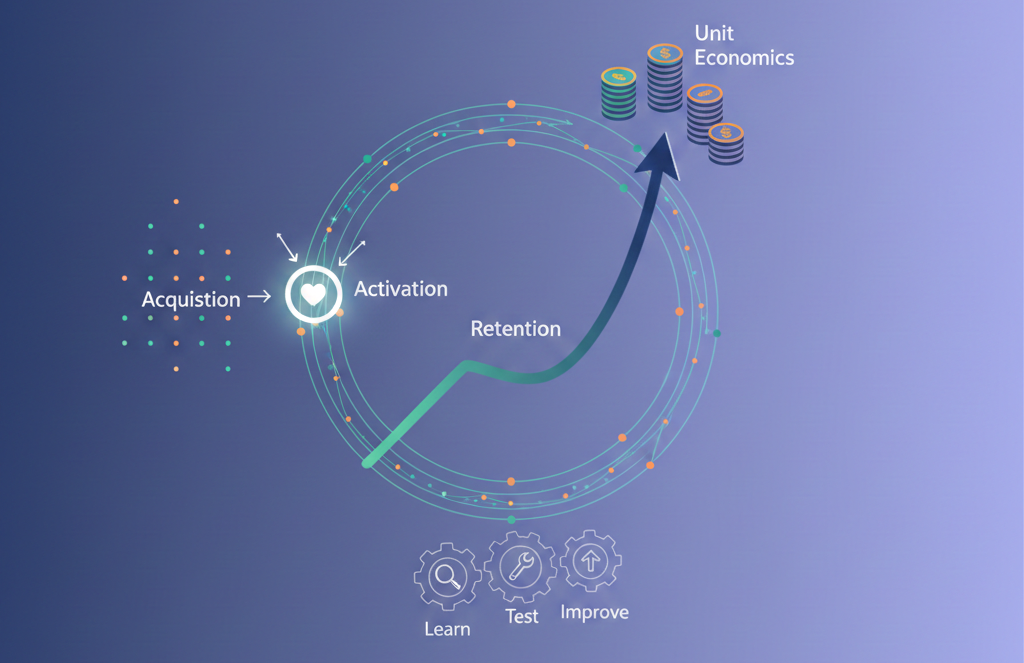
Most early-stage founders I talk to are drowning in data but starving for insight.
They show me dashboards filled with “Total Registered Users” or “Page Views,” but when I ask which lever we should pull to double revenue next month, the room goes silent. This is the SaaS Metric Paradox: the more you track, the less you actually see.
In this guide, I’m stripping away the fluff. You don’t need 50 KPIs; you need a handful of SaaS metrics that tell you the truth about your product-market fit and your path to scale. I’ll share my unified Learn-Test-Improve framework to turn raw numbers into a growth engine.
Why Most Founders Track the Wrong Things
Early in my career, I obsessed over growth hacks. I thought a spike in sign-ups meant we were winning. But behind the scenes, our churn was a nightmare. We were pouring water into a leaky bucket.
I’ve since learned that sustainable growth isn’t about the size of your top-of-funnel; it’s about the velocity and efficiency of the entire machine. This efficiency starts with a deep understanding of your foundational SaaS business model, which dictates how your metrics should actually look.
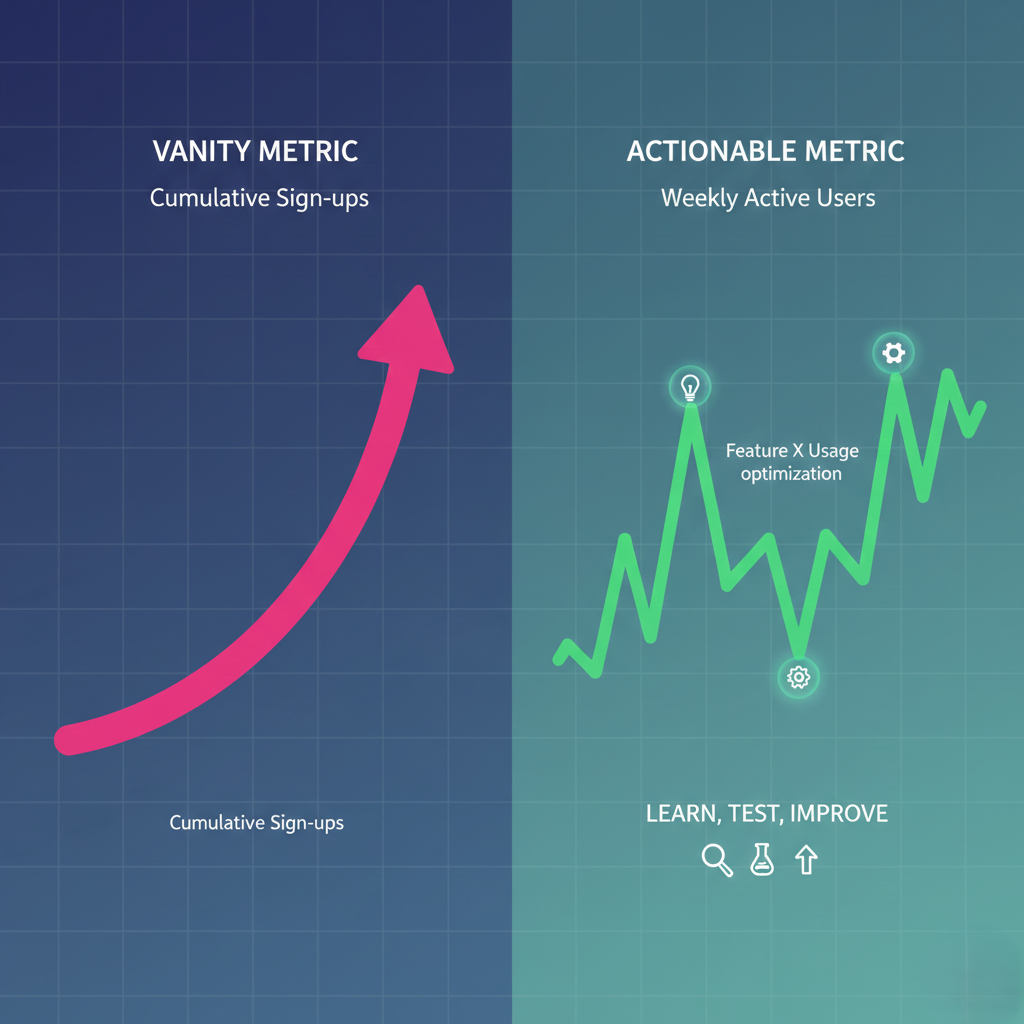
My Realization: If a metric doesn’t tell you exactly what to change in your product or marketing, it belongs in the trash, not on your dashboard.
But how do you know which actionable metrics to prioritize first? To answer that, let’s transition to the first major stage: acquisition, and how you bring people through the door.
Acquisition Metrics: Beyond the Top of the Funnel
In my tests, I’ve found that founders often overcomplicate acquisition. You only need to answer one core question: Can we afford to grow? To answer that, we look at the relationship between cost and time.
- Customer Acquisition Cost (CAC)
CAC is the total spend divided by the number of new customers. But CAC in isolation is a lie. Recent 2026 data from OpenView Partners suggests that while median CAC is rising, it’s the context of the deal size that matters most.
- CAC Payback Period
This is the number of months it takes to earn back the cost of acquiring a customer.
- The Goal: For early-stage SaaS, aim for < 12 months.
- What I saw when I implemented this: By focusing on the payback period rather than just total CAC, we found that our “expensive” LinkedIn ads were actually better than our “cheap” Facebook ads because LinkedIn leads stayed twice as long.
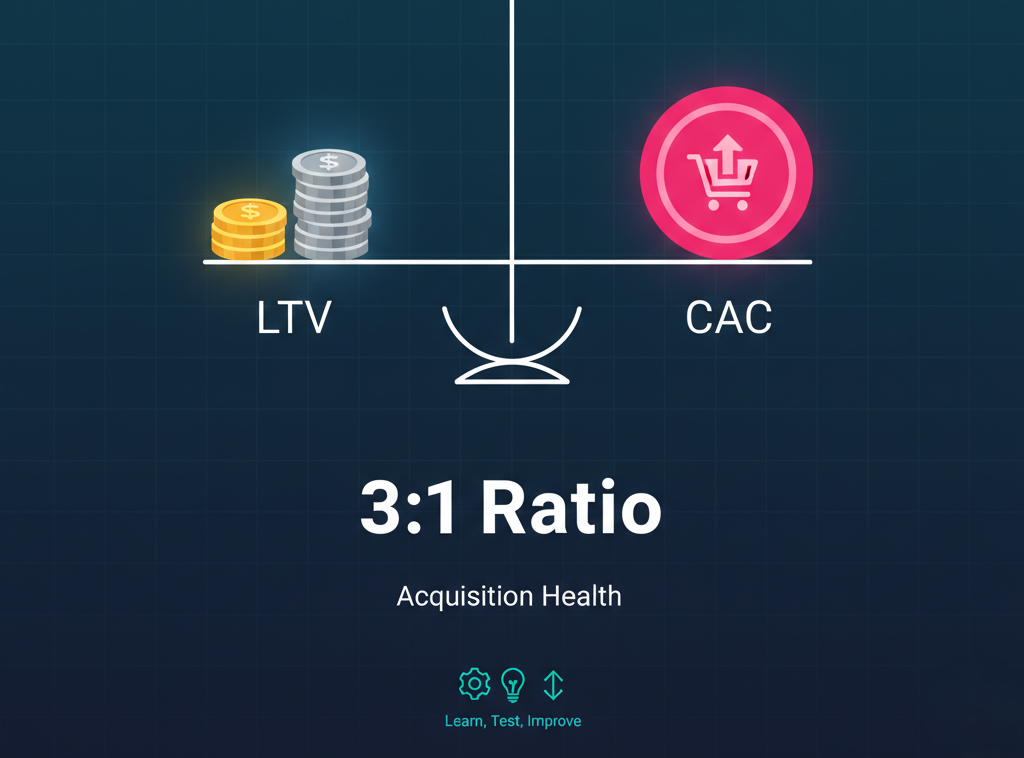
- LTV:CAC Ratio
This measures the long-term value of a customer compared to what you paid to get them.
- Benchmark: A 3:1 ratio is the industry “standard.”
- Personal Critique: If your ratio is 8:1, you aren’t “winning”, you’re actually under-investing. You’re leaving growth on the table because you’re afraid to spend.
Now that we’ve considered acquisition metrics, here’s the hard truth: You can have the most efficient CAC in the world, and it won’t matter if those users drop off ten seconds after signing up. That’s where the most underrated lever in SaaS comes in: Activation.
Activation: The Most Underrated SaaS Metric
If I could only track one SaaS prediction metric, it would be Activation, the user’s Aha! The moment when your product solves their problem.
Defining Your “Aha! Moment” (The Learn Phase)
You have to find the correlation between an early action and long-term retention.
- Slack: When a team sends 2,000 messages.
- Dropbox: When a user puts one file in one folder.
Time-to-Value (TTV)
How long does it take from the moment they sign up to that “Aha!” moment?
- The Test: I once ran an experiment where we removed three fields from the onboarding form and added a “Quick Start” template.
- The Result: TTV dropped from 24 hours to 15 minutes, and our 1-day retention jumped by 20%.
If Activation is the spark, Retention is the steady flame. Now let’s move from ensuring users realize value to keeping them over time. A user who finds their “Aha! Moment” is significantly more likely to stick around, but keeping them requires a different set of eyes on the data.
Retention & Churn: The Heart of Sustainable Growth
I’ve seen countless SaaS products burn through millions because they tried to outgrow a churn problem. According to Harvard Business Review, increasing customer retention rates by 5% increases profits by 25% to 95%.
- Net Revenue Retention (NRR)
NRR measures how much your revenue grows from your existing customer base.
- The Gold Standard: 110%+. This means even if you didn’t acquire a single new customer, your business would still grow by 10% year-over-year.
- Cohort Analysis: The “Leaky Bucket” Detector
Don’t look at average churn; it hides the truth. Instead, use Cohort Analysis. Group users by the month they signed up and track their behavior over time.
Warning: If your cohorts don’t “flatten out” (meaning churn never stops), you don’t have a growth problem; you have a product-market fit problem.
Once you’ve plugged the leaks in your retention bucket, it’s time to shift your perspective from individual users to the entire business. This is where we move from product health to Unit Economics, which determines whether your SaaS is a hobby or a scalable company.
Unit Economics: The “Math” of a Healthy SaaS
To build a sustainable business, you have to move beyond “growth at all costs” and look at the efficiency of every dollar spent. This is the Improve phase of my unified Learn-Test-Improve framework.
- Burn Multiple
Burn Multiple measures how much venture capital you are burning to generate each dollar of Net New Annual Recurring Revenue (ARR). In today’s market, this is the ultimate efficiency test..
- Benchmark: A Burn Multiple of 1.0x is great; 2.0x is the upper limit in today’s market.
- The Rule of 40
A classic benchmark popularized by Brad Feld, which states that your growth rate plus your profit margin should equal 40% or more. It’s the ultimate balancing act between scaling fast and staying healthy.
Knowing these metrics is one thing; seeing them in real-time is another.
Implementation: Building Your Growth Dashboard
You don’t need a $2,000-a-month data stack to start. You need a setup that allows you to focus on the One Metric That Matters (OMTM) for your current stage.
- Pre-Seed: Focus on Activation Rate.
- Seed: Focus on Retention / NRR.
- Series A: Focus on CAC Payback / Scalability.
My Recommended Stack:
- Tracking: Segment or RudderStack (to collect the data).
- Product Analytics: Mixpanel or PostHog (to find the “Aha!” moment).
- Financials: ProfitWell or ChartMogul (to track MRR and Churn automatically).
Conclusion: Metrics are for Action
The Learn-Test-Improve cycle only works if you are looking at the right data. This unified framework helps ensure actionable insights.
- Learn: Identify which metric is currently your bottleneck (is it Activation? Churn?).
- Test: Run a specific experiment to move that needle (e.g., a new onboarding flow).
- Improve: Analyze the result, double down on what worked, and pivot away from what didn’t.
The main takeaway: Focus only on actionable metrics that directly reflect your product’s health and growth engine. By consistently tracking, testing, and improving these key metrics, not just surface stats, you will make better decisions and drive lasting, sustainable growth for your SaaS.
Next step: Review your user cohorts over the last 3 months. If your retention curves aren’t flattening and are instead trending down, prioritize fixing onboarding and core product before investing in further marketing. Sustainable growth depends on solving this first.