You can build an amazing product and still feel like growth is “random.” One month looks great. Next month is flat. And you’re left asking: Is this a real business, or just a string of lucky deals?
That confusion is common when you’re new to the SaaS business model. Because SaaS isn’t just “software you sell online.” The subscription model changes how you make money, how you measure progress, and what “good growth” even means.
In this article, I’ll break down what makes SaaS different without hype or jargon. You’ll learn how recurring revenue works (and why cash ≠ revenue), the unit economics that decide whether you can scale, the pricing models SaaS companies actually use, and the core metrics that tell you if you’re building something sustainable.
No growth hacks. Just the fundamentals you can build on.
SaaS isn’t a product sale; it’s an ongoing service relationship.
At its simplest, the SaaS business model is: customers pay a recurring fee to access software you keep improving and hosting. But the part most founders miss is the ongoing part.
In a traditional software model (or many eCommerce businesses), you sell something once, recognize revenue once, and move on. In SaaS, customers keep paying only if they continue to get value. That makes retention, activation, and expansion just as important as acquisition.
This is also why SaaS businesses often look “slow” early on. A subscription business builds momentum over time. You don’t win by making one big sale. You win by stacking small, consistent renewals and expansions until the base becomes compounding.
Key Takeaway: In SaaS, growth comes from keeping—not just finding—customers.
Recurring revenue changes everything (especially how you think about “sales”)
Recurring revenue is the heartbeat of SaaS. It makes forecasting easier, stabilizes cash flow (eventually), and gives you clearer signals about whether customers truly value what you built.
ARR and MRR are not vanity metrics, if you treat them correctly
You’ll see two common recurring revenue terms:
- MRR (Monthly Recurring Revenue): subscription revenue normalized to a month
- ARR (Annual Recurring Revenue): subscription revenue normalized to a year
They matter because they let you measure progress consistently, even when customers pay monthly rather than annually. Salesforce’s own ARR explanation is a decent reference for how companies typically frame it.
But here’s the catch: ARR/MRR only helps when they’re clean. That means separating recurring revenue from one-time fees (setup, implementation, services) so you don’t fool yourself.
Cash collected ≠ revenue recognized (and it matters more than you think)
If a customer pays you $12,000 for an annual plan, your bank account gets $12,000 today. But accounting rules generally recognize that revenue over the service period (often monthly), because you’re delivering the service over time. Stripe’s overview captures this idea clearly: revenue is recognized as obligations are satisfied, not just when money arrives.
Why you should care (even if you hate finance):
- It keeps you honest about real performance.https://stripe.com/resources/more/a-guide-to-revenue-recognition-for-saas-businesses?utm_source=chatgpt.com
- It prevents “fake growth” from annual prepayments.
- It makes runway planning more accurate when renewals come due.
Key Takeaway: Recurring revenue works if you track it cleanly and grasp cash vs recognized revenue.
The SaaS “growth engine” is retention + expansion (not just new customers)
If you’ve ever felt like you’re on a treadmill—sign new customers, lose old customers, repeat—that’s the SaaS reality when retention isn’t under control.
SaaS rewards businesses that can:
- activate users quickly
- retain them over time
- expand revenue through upgrades, seats, or usage
This is why Net Revenue Retention (NRR) gets so much attention. It answers: If we stopped acquiring new customers today, would revenue from existing customers grow, shrink, or stay flat?
Recent benchmarks show how challenging this has become. Benchmarkit’s 2025 benchmarks report NRR around ~101% (median), suggesting many companies are barely expanding enough to offset churn.
A simple mental model: the SaaS retention ladder
Think of retention in four levels:
- Survive: customers don’t churn immediately.
- Stick: customers build a habit and keep using it
- Rely: customers depend on it for workflows.
- Expand: customers add seats, upgrade plans, or increase usage.
Many early SaaS products never get past level 2. Not because the product is “bad,” but because onboarding, value delivery, and positioning aren’t tight enough.
Key Takeaway: In SaaS, retention isn’t an “after growth” issue, it’s the growth problem.
Having examined how retention and expansion fuel SaaS growth, let’s look at the numbers behind the business model: This is where you find out if your SaaS company can realistically scale.
You can have a great product and still have a broken business model. Usually, the break shows up in unit economics.
Gross margin is a SaaS superpower (when you protect it)
SaaS is attractive because, done well, it can produce strong gross margins. Benchmark data often places median subscription gross margins around the high 70s (with top quartile higher).
Stripe also frames common SaaS gross margin expectations: above ~75% is often considered “good,” with top performers trending 80%+.
But margins don’t stay high automatically. Cloud costs, support load, and heavy onboarding services can quietly crush your margin if you don’t design for efficiency.
Practical ways to protect margin:
- Instrument and reduce cloud waste early (logs, storage, idle compute)
- Invest in self-serve onboarding before scaling paid acquisition.
- Use support content to reduce the number of repetitive tickets.
- keep “services” from becoming a hidden COGS sink
CAC and payback: SaaS punishes expensive acquisition
CAC (Customer Acquisition Cost) is not scary by itself. Slow payback is.
One benchmark source notes that acquisition efficiency has been worsening: Benchmarkit reports the “New CAC Ratio” rising, with a median around $2 in sales & marketing expense to acquire $1 of new customer ARR (their framing).
That trend matters because it means many teams are paying more for growth while retention becomes harder.
A practical rule of thumb many SaaS teams use:
- If your CAC payback is too long, you’re fragile.
- If it’s short, you can reinvest confidently.
- (“Too long” depends on ACV and market, but you should at least know your number.)
LTV is not a guess, tie it to retention reality
LTV works when it’s grounded in:
- gross margin
- churn/retention
- expansion behavior (NRR)
If retention is weak, LTV is weak. And if LTV is weak, “scaling paid” becomes a cash bonfire.
Key Takeaway: A healthy SaaS business model is built on strong margins, a reasonable CAC payback, and retention that makes LTV real.
Pricing models: how SaaS companies actually capture value
Pricing is where strategy becomes math. It’s also where most SaaS founders either undercharge (and can’t afford growth) or overcomplicate (and slow down conversion).
Here are the common SaaS pricing approaches—plus when they work.
1) Tiered subscriptions (good default for many SaaS)
This is the classic:
- Basic → Pro → Business → Enterprise
It works well when customers have clearly different needs and a willingness to pay. It also supports expansion as customers “grow into” higher tiers.
Practical tip: tier by value, not by feature clutter. If tiers look like a checklist war, buyers stall.
2) Per-seat pricing (great when collaboration drives value)
Per-seat works when adding users increases product value. It’s simple to understand and scales naturally with adoption.
Risk: if the product is useful but not used by everyone, buyers resist seat expansion. You’ll see this in tools that are “nice to have” across the org, but critical only for a few roles.
3) Usage-based pricing (works when value scales with consumption)
Usage pricing can align price with value, especially for infrastructure-like products or APIs. But it needs:
- predictable usage drivers
- strong billing transparency
- clear guardrails to avoid “bill shock.”
A hybrid model is common: a base subscription + usage coverage.
4) Freemium (powerful, but not free)
Freemium can work when:
- Your product has low marginal support costs.
- Users can self-serve and reach value fast.
- There’s a natural upgrade trigger (limits, collaboration, scale)
Freemium fails when it floods support, attracts the wrong users, or delays monetization without improving retention.
Key Takeaway: Pricing is part of your SaaS growth system. Choose the model that aligns with how customers get value—not with what competitors do.
With pricing models explored, the next big question is how to measure SaaS performance. Let’s break down which metrics actually matter to cut through the noise.
SaaS metrics can feel endless. The goal isn’t to track everything. It’s to track the few numbers that tell you if the system is working.
The “Core 6” SaaS metrics (start here)
- MRR / ARR – your recurring revenue base
- Churn (Logo + Revenue) – who leaves and how much revenue leaves
- NRR – whether expansion offsets churn
- Gross Margin – how scalable your revenue is
- CAC + Payback – how expensive growth is
- Activation rate / Time-to-value – whether new users get value quickly
If you want one metric that forces balance, the “Rule of 40” is often used as a directional check (growth + profit margin). It’s not perfect, but it’s a useful constraint when teams obsess over growth without efficiency (or efficiency without growth).
A reality check from benchmarks
SaaS Capital’s 2025 benchmarks highlight a connection many founders learn the hard way: better NRR is strongly associated with higher growth rates (their research shows growth improving as NRR improves across ranges).
This is why “just add more leads” often fails. If your retention and expansion are weak, acquisition becomes a leaky bucket.
Key Takeaway: The best SaaS metrics don’t just measure growth; they measure whether growth is sustainable.
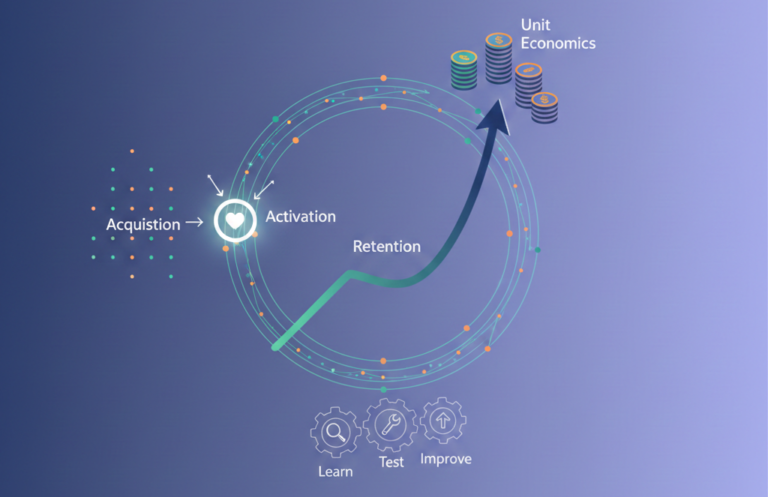
A practical framework: The SaaS Growth Loop (Learn → Test → Improve)
Here’s a simple framework you can reuse across product, pricing, and go-to-market.
Step 1: Learn (find the constraint)
Pick one bottleneck:
- activation is low
- Churn is high
- Expansion is weak
- CAC payback is too long
- margins are getting squeezed
Then pull the data that explains it:
- cohort retention by signup month
- funnel drop-off points in onboarding
- support ticket themes
- “Why did you churn?” responses
- sales calls tagged by lost reason
Step 2: Test (run small, focused experiments)
Run experiments that are:
- cheap to ship
- measurable
- reversible
Examples:
- shorten onboarding to one “first win” path
- change a paywall moment
- Add an annual plan with a clear incentive.
- remove a confusing tier
- improve lifecycle emails for weeks 1–4
Step 3: Improve (lock in wins, kill losers)
If the test works, ship it fully and document it.
If it fails, keep the lesson and move on.
Then repeat the loop.
This is how SaaS companies get “boring growth” that actually lasts.
Key Takeaway: SaaS growth is compounding iteration—learn, test, improve, repeat.
Common mistakes founders make with the SaaS business model
Let’s save you some pain. Here are the patterns that keep popping up.
Mistake #1: Treating ARR like cash
Annual plans generate upfront cash, but your renewal risk builds up over 12 months. If you spend like it’s permanent revenue, you can get crushed at renewal season.
Do this instead: track deferred revenue/renewal calendar and build conservative forecasts. Use revenue recognition thinking even if you’re small.
Mistake #2: Overbuilding tiers and under-explaining value
Too many plans create decision paralysis. And feature-based tiers don’t map to outcomes.
Do this instead: design tiers around customer “jobs” and outcomes, then keep the differences obvious.
Mistake #3: Scaling acquisition before retention is stable
If churn is high, paid growth is often just a matter of renting customers.
Do this instead: fix onboarding + activation first. Retention improvements make every future acquisition channel work better.
Mistake #4: Ignoring gross margin erosion
Cloud + support + onboarding services can quietly destroy your scalability.
Do this instead: track gross margin monthly and treat it like a product metric, not just finance.
Key Takeaway: Most SaaS “growth problems” are business model problems in disguise.
The SaaS business model differs because it’s not a one-time sale—it’s a long-term value exchange. Recurring revenue, retention, and unit economics determine whether you can scale sustainably, and the metrics that matter reflect that reality.
If you want a practical place to start, do these three things this week:
- Define your “first win” (activation) and measure how many users reach it.
- Calculate basic churn and NRR, and review a simple cohort view.
- Check gross margin and map what’s driving COGS.
No hacks needed. Learn, test, improve, then do it again. That’s how real SaaS growth shows up.