
Content-Led SEO for SaaS: A Practical Strategy That Compounds

Quick summary
Content-led SEO for SaaS is not about publishing random blog posts. It is about mapping content to buyer intent, building topical authority, and creating a clear path from organic traffic to qualified leads.
Content-led SEO for SaaS means using useful content as a long-term acquisition channel. Not random blog posting. Not keyword stuffing. Not publishing “best practices” because everyone else does.
The goal is simple: find out what your buyers want to understand, compare, trust, and decide. Then, create content that helps them take the next step.
When done well, content-led SEO does three things for a SaaS business:
- It brings qualified organic traffic.
- It builds trust before a demo or signup.
- It turns search demand into a pipeline over time.
This is why content-led SEO grows stronger over time. A good page keeps working after you publish it. A strong group of related pages helps new content rank more easily. A helpful guide can keep sending people to your audit, trial, demo, or email list long after it goes live.
But most SaaS blogs never reach that point.
They publish disconnected posts. They chase volume. They write for topics, not buyers. Then they wonder why the blog gets traffic but no leads.
The problem is not SEO.
The problem is a weak content strategy.
This guide gives you a practical content-led SEO framework for SaaS. You will learn how to map content to buyer intent, build topical authority, choose the right content formats, connect articles to conversion, and measure whether your content is actually working.
What is content-led SEO for SaaS?
Content-led SEO for SaaS is a growth strategy where content becomes the main way people discover, understand, and trust your product through organic search.
It is different from simply “doing SEO.”
Traditional SEO often starts with keywords.
Content-led SEO starts with the buyer.
The question is not:
“Which keyword has the highest search volume?”
The better question is:
“What is the buyer trying to solve, and what do they need to believe before they can take the next step?”
This change makes a big difference.
You stop writing isolated articles. You start building a system.
A good content-led SEO system connects:
- product problems
- search intent
- topic clusters
- helpful content
- internal links
- conversion paths
- trust signals
- measurable business outcomes
Simply put, content-led SEO is not just about blogging.
It is about building a pipeline.
What content-led SEO is not
Content-led SEO does not mean publishing 50 articles and hoping Google sends traffic.
It does not mean copying competitors’ headings.
It does not mean writing “What is X?” posts for every keyword in your niche.
It does not mean turning AI into a content factory.
That kind of content might seem active, but it rarely builds trust or brings in revenue.
Google’s own guidance keeps coming back to the same idea: helpful, reliable, people-first content wins. SEO should help search engines understand useful content. It should not be the reason the content exists.
For SaaS, this matters even more.
Your buyer is not just reading for entertainment. They are trying to make a decision. They may compare tools. They may need approval from a manager. They may worry about cost, migration, integrations, security, or whether your product is the right fit.
Thin content does not answer those questions.
A real content-led strategy can.
Why SaaS companies need content-led SEO
SaaS buyers rarely buy the first time they hear about a product.
They search. They compare. They ask questions. They read reviews. They look for examples. They check pricing. They discuss internally. Then they decide.
This is why content-led SEO fits SaaS so well.
A SaaS product usually solves a specific problem. That problem creates search demand around:
- symptoms
- workflows
- alternatives
- comparisons
- templates
- calculators
- use cases
- integrations
- implementation questions
- pricing concerns
- risk and trust questions
Each of these searches is a chance to meet the buyer before they are ready to talk to sales.
For early-stage SaaS, this is especially useful.
You may not have a huge ad budget. You may not have a big brand. You may not have thousands of backlinks.
But you can still build a focused content system around the problems your product solves.
This is your advantage.
Paid ads rent attention.
Content earns attention.
When you map your content well, that attention turns into signups, demos, audits, or trials instead of just traffic.
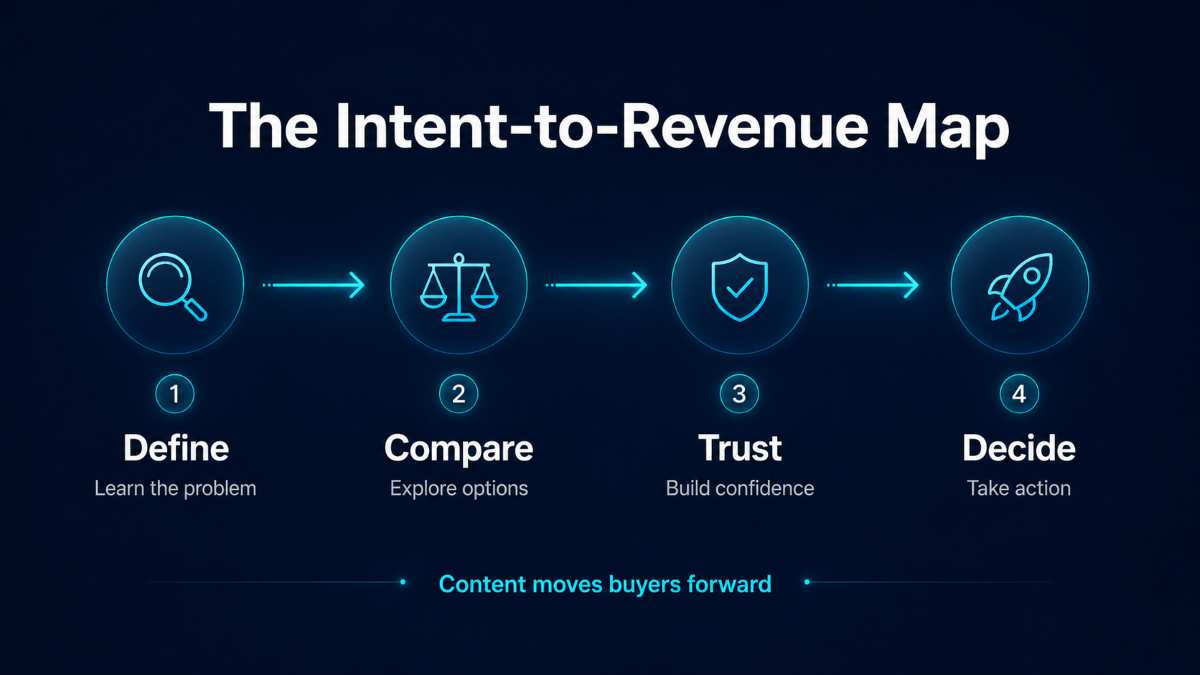
The Intent-to-Revenue Map
Here is the framework I use for content-led SEO.
Every SaaS buyer hires content to do one of four jobs:
1. Define
The buyer is asking: “What is this, and why does it matter?”
Best content types:
- Guides
- Explainers
- Glossaries
- Beginner posts
Main metric:
- Rankings
- Impressions
- Assisted traffic
Best CTA:
- Newsletter
- Related guide
2. Compare
The buyer is asking: “What are my options?”
Best content types:
- Alternatives
- Comparisons
- Best tools
- Category pages
Main metric:
- Engaged sessions
- Clicks on product pages
Best CTA:
- Free audit
- Checklist
- Comparison download
3. Trust
The buyer is asking: “Can I believe this source?”
Best content types:
- Teardowns
- Original analysis
- Case studies
- Data-backed posts
Main metric:
- Return visits
- Branded search
- Assisted conversions
Best CTA:
- Audit
- Email list
- Consultation
4. Decide
The buyer is asking: “Is this right for me now?”
Best content types:
- Use-case pages
- Templates
- Product-led guides
- Implementation pages
Main metric:
- Leads
- Signups
- Demos
- Audit requests
Best CTA:
- Demo
- Free audit
- Trial
Most SaaS blogs are stuck in the Define stage.
They explain the basics again and again.
That is safe. It is easy. It feels productive.
But it is rarely enough.
The money usually sits closer to Compare, Trust, and Decide. These pages may have lower search volume, but the reader has stronger intent.
A buyer searching for “what is Facebook group lead generation” is learning.
A buyer searching for “best Facebook group lead generation tools” is comparing.
A buyer searching “Groupboss alternative” or “how to collect Facebook group answers into Google Sheets” is much closer to action.
This is the key difference.
Content-led SEO works when you build for the whole journey, not just the top of the funnel.
A real way to think about this
In SaaS growth work, I have seen one mistake repeat often: teams treat the blog as a traffic machine, not a decision-support system.
They publish educational content, but the reader has nowhere meaningful to go next.
No comparison page.
No use-case page.
No checklist.
No audit.
No clear CTA.
So the article may rank. It may even get clicks. But it does not help the business.
This is not just a content problem. It is a strategy problem.
Every article should answer two questions before publishing:
- What decision does this help the reader make?
- What next step should the reader take after reading?
If you cannot answer those two questions, the article is not ready.
How to build a content-led SEO strategy for SaaS
Here is a practical step-by-step process.
1. Start with product problems, not keywords
Before opening any SEO tool, list the problems your SaaS solves.
Use the buyer’s language.
Not internal feature names.
For example, a SaaS team might say:
- CRM integration
- Workflow automation
- Lead capture
- Reporting dashboard
But the buyer may say:
- How do I collect leads from my Facebook group?
- How do I send new leads to Google Sheets automatically?
- How do I avoid copying form answers manually?
- Which tool connects Facebook group questions to Mailchimp?
The buyer’s language is where good SEO starts.
Once you list these real problems, group them into topic clusters.
A topic cluster is not just a group of similar keywords. It is a group of related buyer problems your product can credibly answer.
This last point is important.
Do not build clusters around topics you cannot help with. They may bring traffic, but they will not bring the right traffic.
2. Map each problem to buyer intent
After you list the problems, map them to the four jobs:
- Define
- Compare
- Trust
- Decide
Let’s say your SaaS helps Facebook group admins collect leads.
A simple cluster may look like this:
Define: What is Facebook group lead generation?
Compare: Best Facebook group lead generation tools
Trust: Manual lead collection vs automation: which is better?
Decide: How to collect Facebook group answers into Google Sheets
Now you have a journey.
The reader can start with a broad problem and move toward a practical solution.
This is where internal linking becomes powerful.
Your Define article should not be a dead end. It should link to the Compare article. The Compare article should link to the Decide page. The Decide page should point to your audit, demo, or trial.
This is how your content leads to revenue.
3. Build one full cluster before scaling
Do not start by publishing twenty random posts.
Build one complete cluster.
A simple SaaS cluster can include:
- 1 pillar page
- 2–3 educational guides
- 1 comparison page
- 1 use-case page
- 1 template or checklist
- 1 product/solution page
- 1 FAQ or troubleshooting page
The pillar page gives the topic structure.
The supporting pages go deeper.
The internal links connect everything.
This helps readers because they can move through the topic naturally. It also helps Google understand that your site covers the topic in depth.
This is what topical authority looks like in practice.
It is not about writing one huge article that tries to cover everything.
Instead, create a group of useful pages, each with a clear purpose.
For the full method, read: How to Build a SaaS Topic Cluster.
4. Match the content format to the search intent
A common SaaS SEO mistake is writing the right topic in the wrong format.
A “best tools” query needs comparison.
A “how to” query needs steps.
A “template” query needs a usable template.
A “calculator” query needs a calculator or at least a worked example.
A “vs” query needs a direct comparison, not a vague product story.
Before writing, search for the keyword manually and study the live results.
Ask:
- Are the top results guides, tools, templates, or listicles?
- Are they short or detailed?
- Do they include tables?
- Do they show examples?
- Do they answer the query directly?
- What is missing from all of them?
Do not copy the top results.
Use them to understand the expected format. Then add something better.
Better can mean:
- a clearer framework
- a real example
- a comparison table
- a downloadable checklist
- screenshots
- original analysis
- a stronger explanation
- a practical next step
This is how your content becomes useful instead of generic.
5. Add an original layer to every important page
If your article says the same thing as ten other articles, it has no reason to exist.
This might sound harsh, but it is true.
For SaaS content, the original layer can be simple:
- your own framework
- a teardown
- a real workflow
- a screenshot
- a checklist
- a mistake you noticed
- a comparison table built from actual product research
- a small dataset
- an example from your work
- a legal, pricing, or compliance angle that competitors have ignored
This is where RakibulSumon.com should stand out.
The site should not sound like another generic marketing blog.
It should feel like:
“I worked through this problem. Here is what I learned. Here is the system you can use.”
This approach builds more trust than just repeating the same advice as everyone else.
It is also more useful for the reader.
6. Write for readers, structure for search
Good SaaS content should be easy to read and easy to understand.
That means:
- short intro
- direct answer early
- clear H2/H3 hierarchy
- short paragraphs
- simple examples
- tables where they help
- descriptive internal links
- original images or diagrams
- FAQ section
- visible author information
- clear updated date
The reader should not have to struggle with the page.
Google also recommends creating helpful content, using words people would search for in important places, making links crawlable, and using descriptive text for links and images.
So here is the simple rule:
Write for humans.
Structure so search engines can understand it.
These two things should work together, not compete with each other.
7. Connect every page to the next step
A SaaS blog without calls to action is just a library.
A SaaS blog with the wrong calls to action is just a billboard.
A good content-led SEO system uses the right CTA for the reader’s stage.
Use this simple rule:
Define-stage content: soft CTA such as newsletter, related guide, or checklist.
Compare-stage content: medium CTA such as audit, comparison checklist, or buyer guide.
Trust-stage content: medium CTA such as audit, teardown, or consultation.
Decide-stage content: hard CTA such as demo, trial, free audit, or sign up. Do not push a demo call to action on every beginner article. It can feel too soon.rly.
But do not let high-intent pages end with just “hope this helped.”
A reader at the Decide stage needs a clear action to take.
For this site, the strongest CTA is:
Get a free SaaS SEO audit.
It is useful, relevant, and tied to the article’s promise.
What will Google and AI search change in 2026
AI Overviews and AI search features changed how people see search results. But the foundation has not disappeared.
Google’s guidance for appearing in AI features still points back to the same basics: meet technical requirements, follow Search policies, and create helpful, reliable, people-first content.
So the answer is not to chase every “GEO hack.”
The answer is to build content that deserves to be cited, trusted, and clicked.
In 2026, the safest SaaS SEO strategy is:
- avoid thin summaries
- avoid mass-produced pages with no added value
- avoid fake freshness
- avoid unsupported claims
- avoid keyword stuffing
- add real expertise
- show first-hand experience
- build useful pages around real buyer problems
- keep pages technically clean and easy to crawl
Google’s Search Status Dashboard shows multiple ranking-related updates in 2026, including core and spam updates. The exact weighting behind those systems is not public. So I do not recommend building a strategy around guesses.
Build around what Google keeps saying publicly:
Helpful content. Clear structure. Real value. Trust.
This advice might seem boring.
But it is the advice that lasts through updates.
The content types every SaaS should build
A strong SaaS content system usually needs more than blog posts.
Here are the core content types to consider:
| Content Type | Best For | Example |
|---|---|---|
| Pillar guide | Building topic authority | Content-led SEO for SaaS |
| Problem guide | Capturing early demand | How to collect leads from a Facebook group |
| Comparison post | Capturing commercial intent | Best Facebook group lead generation tools |
| Alternative page | Winning switchers | Best [competitor] alternatives |
| Use-case page | Turning interest into action | Facebook group lead capture for coaches |
| Integration page | Capturing workflow demand | Send Facebook group leads to Mailchimp |
| Template/checklist | Email capture and lead magnet | SaaS SEO content audit checklist |
| Teardown | Building trust | Why this SaaS blog ranks but does not convert |
| Case study | Proof | How one cluster generated qualified audit requests |
You do not need all of these at once.
Start with the ones closest to revenue.
For many SaaS sites, that means comparison, use-case, integration, and high-intent problem pages.
Then build supporting educational content around them.
How internal links turn content into a system
Internal links are not only for SEO.
They are also for movement.
A reader should never reach the end of a useful page and feel stuck.
Every page should point to the next useful step.
For example:
- A beginner’s guide links to a comparison post.
- A comparison post links to a use-case page.
- A use-case page links to a free audit or demo.
- A content audit guide links back to the pillar page.
- A product-led SEO article links to the content-led SEO pillar.
This creates a helpful loop for your readers.
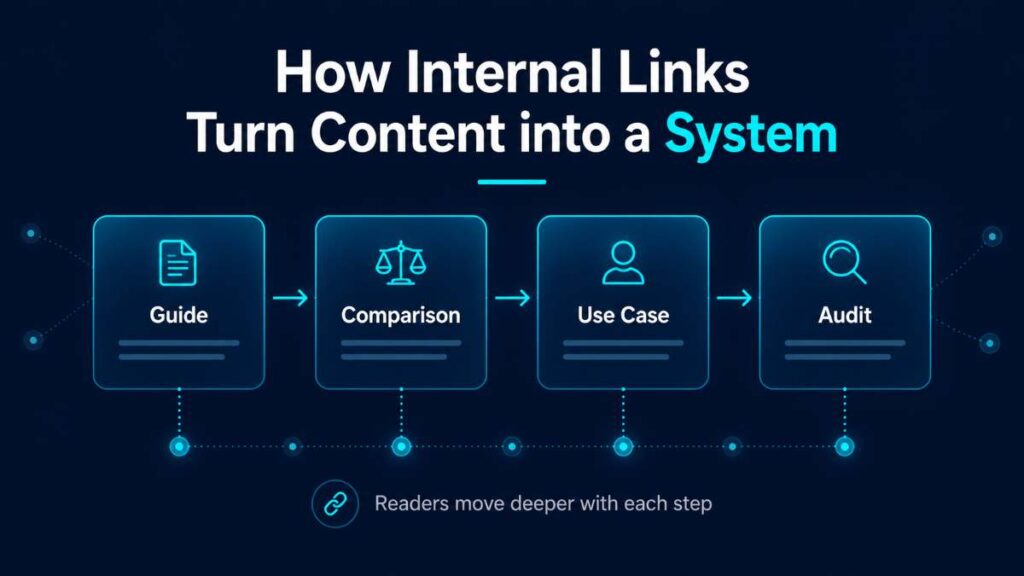
Readers can move deeper.
Google can crawl the topic structure.
Your important pages get more internal authority.
And your content stops acting like a collection of separate blog posts.
It becomes a system that drives growth.
How to measure content-led SEO without fooling yourself
Traffic is not the final metric.
Traffic is only useful when it supports a business goal.
Measure content based on the job it was created to do.
Define-stage content
Track:
- impressions
- rankings
- organic clicks
- internal link clicks
- newsletter signups
- assisted conversions
Do not expect these pages to convert much. Their main job is to introduce the topic and guide the reader to the next step.
Compare-stage content
Track:
- engaged sessions
- scroll depth
- Comparison Table Interaction
- clicks to product/use-case pages
- audit clicks
- branded search growth
These pages should attract readers who are closer to making a decision.
Trust-stage content
Track:
- return visits
- direct traffic
- branded search
- email subscribers
- audit requests
- qualitative feedback
Trust-building content may not lead to immediate conversions, but it can make future conversions easier.
Decide-stage content
Track:
- demo requests
- free audit requests
- trials
- signups
- contact form submissions
- revenue influenced
These are the pages where business impact should be visible.
If a Decide-stage page gets traffic but no action, try improving the offer, CTA, proof, or the page’s focus.
A simple 30-day starting plan
If you are starting content-led SEO from zero, do not overcomplicate it.
Use this 30-day plan.
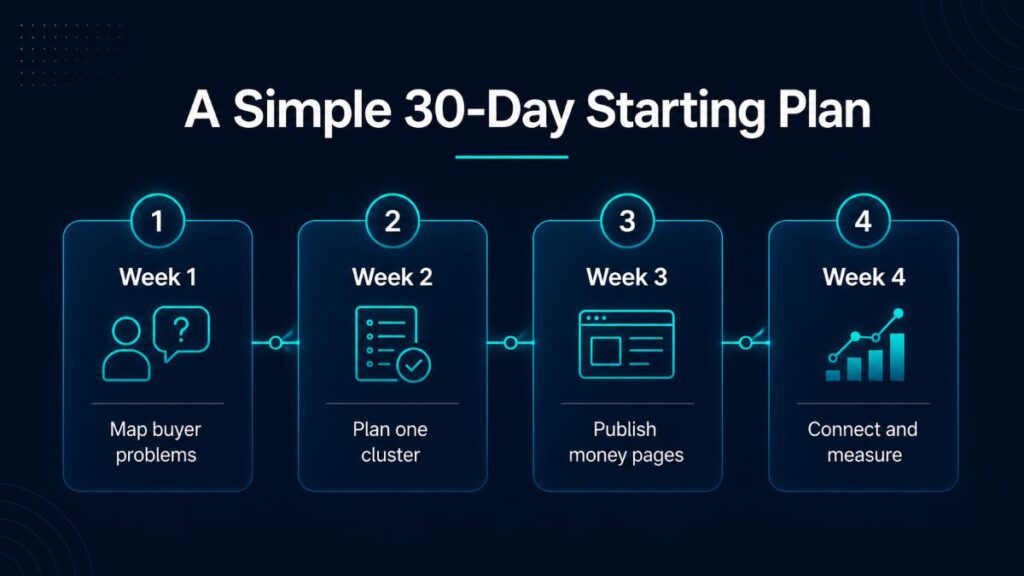
Week 1: Map the buyer’s problems
List 10–20 real buyer problems.
Group them into 2–3 topic clusters.
Choose the cluster closest to revenue.
Week 2: Build the cluster plan
For that cluster, plan:
- one pillar page
- one comparison page
- one use-case page
- one practical guide
- one template/checklist
- one FAQ or troubleshooting page
Map each page to Define, Compare, Trust, or Decide.
Week 3: Publish the money pages first
Start with the pages closest to action:
- comparison
- use-case
- integration
- template
- audit/demo page
Do not wait to publish your conversion pages. Build the path as soon as possible.
Week 4: Publish the pillar and connect everything
Publish the pillar page.
Add internal links both ways.
Make sure every page has one clear next step.
Then track what happens in Google Search Console and analytics.
You do not need a massive content calendar to get started.
You just need one complete path that takes someone from search intent to conversion.
Common mistakes to avoid
Publishing only top-of-funnel content
Top-of-funnel content can bring in traffic. But if that is all you publish, your blog may grow while revenue stays the same.
Balance educational content with comparison, trust, and decision content.
Writing before checking the SERP
Search intent is visible in the live results.
If Google is ranking templates, do not publish only a long opinion piece.
If Google is ranking comparison tables, add one.
Format matters.
Using AI without adding experience
AI can help with research, structure, and editing.
But it cannot replace your actual perspective.
If a page has no original insight, example, screenshot, framework, or real judgment, it will feel generic.
Readers notice.
So does search.
Treating every CTA the same
A beginner reader may not be ready for a demo.
A high-intent reader may need a strong CTA.
Match the CTA to the reader’s stage.
Ignoring old content
Content-led SEO is not only about publishing.
It is also refreshing, merging, pruning, and improving.
Review your content every quarter.
Ask:
- Does this page still match intent?
- Is the information current?
- Does it link to the right next step?
- Is it earning impressions but not clicks?
- Is it getting traffic but no conversions?
- Should it be merged with a stronger page?
A strong content system improves over time.
Where to start
Start with one cluster.
Not twenty blog posts.
Choose one buyer problem your SaaS can genuinely solve. Build the full path around it:
- Explain the problem.
- Compare the options.
- Build trust with proof or analysis.
- Help the reader decide.
- Offer a clear next step.
This is what content-led SEO for SaaS looks like.
No more content.
Better content.
Connected content.
Content that helps the buyer move from search to decision.
If you want to see where your current SaaS content is leaking traffic, trust, or pipeline, start here:
Get a free SaaS SEO audit: https://rakibulsumon.com/free-audit
I will map your existing pages against the Intent-to-Revenue Map and show which content gaps are costing you qualified leads.
FAQ
Is content-led SEO still worth it for SaaS in 2026?
Yes, but weak content is easier to ignore now. Content-led SEO still works when your pages are useful, original, structured, and tied to real buyer problems. The old approach of publishing generic articles around keywords is much weaker.
How long does content-led SEO take for SaaS?
Usually several months. It depends on your domain strength, competition, topic difficulty, publishing quality, internal links, and how close your content is to buyer intent. If you need fast validation, use paid or outbound while your SEO content matures.
How much content does a SaaS need?
Enough to cover a topic properly. One complete topic cluster with a pillar, supporting guides, comparison content, and decision pages can outperform dozens of disconnected blog posts.
What is the difference between content-led SEO and product-led SEO?
Content-led SEO uses editorial content to build trust, educate buyers, and capture demand. Product-led SEO uses product data or user-generated data to create pages at scale. They can work together, but most SaaS businesses should first build a strong content-led foundation.
What should a SaaS publish first?
Start with pages closest to revenue: comparison pages, use-case pages, integration pages, and practical guides that solve urgent buyer problems. Then build broader educational content around those pages.
Can AI help with content-led SEO?
Yes, but only as support. AI can help with research, outlines, editing, and structure. It should not replace first-hand experience, original examples, product knowledge, or expert judgment.

Rakibul Sumon
Rakibul Sumon is a SaaS growth enthusiast who documents his experiences with SEO, content, branding, and sustainable SaaS growth. He believes growth is driven by curiosity, experimentation, and sharing knowledge.
Read more from Rakibul SumonLearning in public